Tuesday, September 22, 2015

CHAIN OF FELLOWSHIP

PAUL’S SEVEN-LINKED CHAIN OF FELLOWSHIP


Fellow-heirs (Eph. 3:6)—of One Inheritance
Fellow-members (Eph. 3:6)—of One Body
Fellow-partakers (Eph. 3:6)—of One Calling
Fellow-citizens (Eph. 2:19)—of One home
Fellow-laborers (Eph. 4:3)—of One Master
Fellow-soldiers (Phil. 2:25)—in One Warfare
Fellow-prisoners (Rom. 16:7)—in One Hope. 

Wednesday, September 16, 2015

Chart: Mary's Magnificat

OLD TESTAMENT PARALLELS TO MARY’S MAGNIFICAT________________________________

Luke
Phrase
Psalm
Other Old Testament
1:46
My soul exalts the Lord
34:3; 35:9; 103:1-2; 145:21
Isaiah 61:10
1:47
My spirit has rejoiced in God my Savior

Habakkuk 3:18
1:48
He has regard for the humble state of His bondslave

1 Samuel 1:11; Genesis 30:13; Malachi 3:12
1:49
Mighty One has done great things
126:3; 71:19-21
Job 5:9
1:49
Holy is His name
111:9
Exodus 15:11; Isaiah 47:4; 6:3
1:50
His mercy is upon generation after generation toward those who fear Him
103:17; 118:4; 145:19; 147:11
Exodus 20:6; 1 Kings 8:23
1:51
He has done mighty deeds with His arm
89:11; 98:1
Exodus 15:6-7; Isaiah 40:10; 51:9; 52:10
1:51
He has scattered those who were proud
33:10; 59:11
Job 5:12-13; Daniel 4:27
1:51
The thoughts of their hearts

Genesis 6:5; 8:21; Deuteronomy 29:19
1:52
He has brought down rulers

Job 12:19
1:52
Has exalted those who were humble
107:40-41; 113:6-8
Job 5:11; 24:24; Ezekiel 17:24
1:53
He has filled the hungry with good things
34:10; 107:9; 146:7
Isaiah 65:13
1:54
He has given help to Israel His servant

Isaiah 41:8
1:54
In remembrance of His mercy
98:3

1:55
As he spoke to our fathers
105:8
Genesis 18:18; 22:17; Isaiah 46:3-4; 49:14-16; 63: 7-16: Jeremiah 31:3; 33:24-26: Micah 7:20;
1:55
To Abraham and his descendants forever

Genesis 17;19


Friday, September 11, 2015

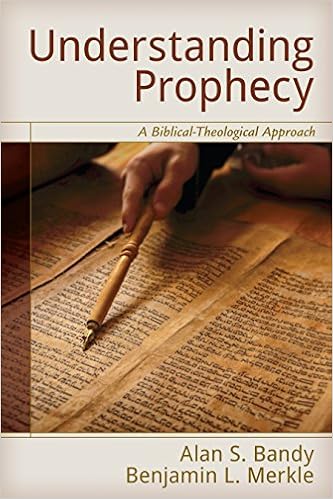
Book Review: UNDERSTANDING PROPHECY


UNDERSTANDING PROPHECY: A Biblical-Theological Approach, Alan S. Bandy & Benjamin L. Merkle, Kregel Academic, Grand Rapids MI, 2015

The aim of this book is to give the reader a framework of how to interpret any passage in the context of the Bible (p.9). The book is unique because the authors have different views of prophecy. Brandy is a historic premillennialist and Merkle is an amillennialist, however both seem to be writing from a covenant theology view. The emphasis seems to uplift areas they have in common and downplay the differences. They also write from a biblical-theological approach, as the title states.

The book is divided into three sections:

Chapters 1-3, deal with the general subject of prophecy and the biblical-theological approach. They clearly uphold inspiration pointing out that “Prophecy is the vehicle for divine revelation” (p. 17). They clearly bring out that the term eschatology is “slippery” term referring to different aspects of the term which can be all-encompassing theologically. They give good keys to understanding prophecy, including the progressive nature of prophecy, thematic, Christocentric, and to be seen from a Biblical-theological perspective. Their general view is to downplay the popular culture caught up in the idea that prophecy is mainly predictive of the future (although they do not deny it, they certainly downplay it), looking more at historical context and its relevance to the original readers. They clearly hold that most prophecy is not predictive in nature, rather centers upon aspects of repentance, social justice, and theological understanding in the historical context of the prophet. Prophecy is primarily forth-telling, and only a small part is fore-telling. They hold that the messages of the prophets are encapsulated in three points:
  • The covenant has been broken, therefore repent!
  • If you refuse to repent, then judgment.
  • Yet, there is hope beyond the judgment for a glorious, future restoration.

These points are well taken. They go on to deal with the forms of prophecy (poetry, pose, apocalyptic, and the challenge of symbolism (which is an attack on the dispensational method). It gives the reader their idea of what biblical theology is, and how it deals with prophecy. To their credit they declare the important presupposition of biblical theology, which all can appreciate:
·         The Bible is God’s Word.
·         God’s Word has a unified message.
·         The unified message of God’s Word centers on Jesus.
·         Jesus’ death, resurrection, and ascension are the climax of redemption history.

Chapters 4-6 focus on Old Testament prophecy. In these chapters they center up the types of Old Testament prophecy: unconditional, conditional, and fulfilled prophecy. They take time to discuss restoration prophecies (Chapter 5). They admit that many passages point to the restoration of Israel, however, they are overly cautious of literal fulfillment of these prophecies. They seem to be more than willing that those should be interpreted mainly symbolically. The reasons in the nature of biblical religion, the unique genre of biblical prophecy, symbolic manner in which the New Testament interprets Old Testament prophecies, and the role of Jesus’ death and resurrection in salvation history. They seem to be saying that these descriptions are fulfilled in some type of code—“The meaning is not expressed in the actual language, but through the actual language of the prophecies” (page 123). The last area they center upon is the Messianic Prophecies that center upon the three offices of Christ—priest, prophet, and king.

Chapters 7-10 deal with the New Testament prophecies. This section is divided into three areas: the coming of Messiah in the gospels and Acts; the epistles, and the book of Revelation. In this section they deal with major prophecy areas in the New Testament. I was especially interested in their comments on the Olivet Discourse. I was somewhat unsatisfied in their treatment; much was oversimplification on the views, especially the futurist view. Although I found their view, “Already-Not Yet” was somewhat interesting, and brought in some good points. Their comments about “left behind” are noteworthy.

In the epistles they center upon the last days. They reject a pretribulational rapture, and the doctrine of the any moment return of Christ. They clearly hold that at least four events must happen before the return of Christ—the gospel preached to the whole world; the conversion of all Israel; the great tribulation; and the coming of Antichrist. They fail to see any differences between the gospels, epistles, and Revelation; common among Covenant theologians.

On Revelation they readily amid that it is one of the most difficult books of the Bible to interpret (p. 224). They take the view that the key of understanding symbolism and spend much of the chapter of this. In the areas of book they consistently chose the figurative or symbolic interpretation. This is true of their overall approach to prophecy saying in their conclusion: “We must resist becoming obsessed with knowing the details of the future because it takes us beyond Scripture into the realm of speculation” (p. 242).

This work on prophecy centers upon common elements between the two authors. The only place that shows disagreement is the two appendixes, and they are very limited: Future conversion of Israel with Bandy seeing it a mass conversion of ethnic Israel in the future. Merkle on the other hand sees it as referring to the Ethnic elect remnant through all history. The other hand is the meaning of the Millennium; which Bandy holds a historical premillennialist and Merkle holding to the amillennialist view. Otherwise, in the major portion of the book one would be hard press to see any difference between the two. There are more differences between historical premillennialist and amillennialist than what are given in the book. Part of the reason for this is both are coming from a Covenant theological view. They downplay literal interpretation of prophecy and the futurist views, and magnify the non-literal view. Do not get me wrong, there are areas in the book that all will agree with, but to me it was lacking and not a satisfying treatment of the subject. They seem to have sacrificed their distinctiveness on the altar of unity.


I received this book free from Kregel Publications for the purpose of reviewing it. I was not required to write a positive review. The opinions I have expressed are my own. I am disclosing this in accordance with the Federal Trade Commission's 16 CFR, Part 255. 

Tuesday, September 8, 2015

Thoughts on John 1:4-5


In John 1:4-5 we come face to face with the literary chain of sorites,[1] (life, life, light, light, darkness, and darkness).[2] These expand on the Word’s participation in creation in this context; later John will expand to salvation, but not here.[3] Notice in creation He is the source of life, his first creative act was light, and the existing darkness was not able to overtake the light. The context of these verses is creation centered. There are three features of the work of Christ in creation:
  • Life—“In Him was life, and the life was the Light” (1:4). There is a parallel to the self-existing life of the Godhead in John 5:26. Life was not created rather it was given (cf. Genesis 2:7; Acts 17:25). There are two clear implications: First, Christ is the life source. Christ empowered the creation with life. He is the source of all life. Second, and somewhat difficult to understand is that His life shared became light, for His “life was the Light of men.” The article used with light in this context is Anaphoric, meaning it is an amplification of life.[4]  Carson correctly states: 
If 1:4...is read in the context of the first three verses, it is more likely that the life inhering in the word is related not to salvation but to creation. The self-existing life of the word was so dispensed at creation that it became the light of the human race...At least in this verse, John is more interested in the source of light (the life of the word) and its purpose (for the human race) than in the mode or purpose of its dispersal.[5]
MacLeod makes three suggestions on this life as light:[6] First, the given life gave significant light in that it was the communication of the knowledge of God. Second, it could be the reflection of God that is seen in His creation (natural or general revelation). Romans 1:20. Third, it is the direct communication that the Lord had with Adam and Eve in the garden. I favor the first suggestion which indicates that there is something in man that knows there is a supreme being—the image of God. From it man has the natural illumination of reason and conscience, insufficient as that may be to bring one to the point of salvation—cf. Romans 2:15.
  • Light—“The Light shines in the darkness” (1:5a). Notice that the word “shines” is in the present tense, indicating that innate light of creation still is active in man. It continues in spite of man’s rebellion/darkness. This is a clear allusion to the fall (Genesis 3). “The light shone in the darkness of the act of creation, and it continues to shine in the darkness of fallen humanity.”[7] This light anticipates the greater light of the Incarnate Christ and the light He gives in salvation (John 1:14). Harris notes “The question of whether John has in mind here the pre-incarnate Christ or the incarnate Christ is probably too specific.”[8] John is using the old creation to set up the light which shines in the work of Jesus Christ.
  • Darkness—“The darkness did not comprehend it.” Darkness in John is positive evil and it speaks of being the environment of the lost. In the plan of God, darkness cannot overtake the power of light. There has been debate over the translation of comprehend. The Greek word is katalambano, meaning to grasp, obtain, to lay hold of, overtake, apprehend, or comprehend. Many take the word to indicate that it has no power to overtake the light and suggest a better translation would be “overpower.” Darkness cannot penetrate or extinguish the light. This statement is in the aorist tense indicating that the failure of overpowering took place in the point of time—at the Cross.


[1]  Sorites: an argument consisting of propositions so arranged that the predicate of any one forms the subject of the next and the conclusion unites the subject of the first proposition with the predicate of the last. (Merrian-Webster’s Collegiate Dictionary, 11th Edition). It is sometimes referred to as the paradox of the heap, for the Greek word means heap.
[2]  Craig Keener, THE GOSPEL OF JOHN, [Peabody MA, Hendrickson, 2003], 1:383.
[3]  MacLeod, “The Creation of the Universe by the Word: John 1:3-5,” 197.
[4]  See Daniel Wallace, GREEK GRAMMAR: BEYOND THE BASICS, [Grand Rapids MI, Zondervan, 1996], 217-220.
[5]  D,A, Carson, PNTC: THE GOSPEL ACCORDING TO JOHN, [Grand Rapids MI, Eerdmans, 1991], 119.
[6]  MacLeod, ‘The Creation of the Universe by the Lord: John 1:3-5,” BIBLIOTHECA SACRA, January 2003, 197-198.
[7]  George Beasley-Murray, WBC: JOHN, [Waco TX, Word, 1987], 11.
[8]  Harris, JOHN, [1:5], www.Bible.org, n.p. 

Sunday, September 6, 2015

Book Review; Comfort's Commentary


Philip Westley Comfort, A COMMENTARY ON THE MANUSCRIPTS AND TEST OF THE NEW TESTAMENT, Grand Rapids MI, Kregel Academic, 2015.

Philip Comfort is well-known for his writings concerning the Greek text. In this latest one he gives a handy aid for anyone who uses the Greek text. It is really a commentary on the variants found in the many New Testament manuscripts, arranged in order of their appearance in the New Testament. However, I found it is more than that. In addition, Comfort has a very helpful introduction. I found it well worth reading. He gives special features of his work:
  • He seems to center on 2nd Century manuscripts, although he does not neglect the others. I personally like this emphasis over some of the other textual mythology. Clearly these would be closer to the originals.
  • He brings out the nomina sacra (sacred names). These are special markings in the manuscripts that do not appear in any printed Greek text. In the manuscripts they are presented with special calligraphy to distinguish the names as sacred. He points them out in his commentary—claiming no other commentary does so. He also has a full appendix of the Significance of the Nomina Sacra. This gives this work added value.
  • He gives a list of the earliest manuscripts for each chapter of the New Testament (i.e. Matthew 1 = P1).
  • He also gives an annotated list of the manuscripts of the New Testament (Chapter 2).

The heart of the book is the running commentary of the Greek text variants—giving his view of the correct one and showing the others. Each has the manuscript information in which they are found. Comfort clearly confesses that in some cases the original reading cannot be determined and gives options for the reader. Another feature of this book is that everything is given in English, so one who is not well versed in the Greek text can still gain valuable information from this work.

This will be a handy reference for any Pastor, student, or a well verse layman who spends time in the study of the Bible. It is compact, organized for quick use, and gives good information in a concise, reader friendly way. Its most valuable contribution is in the area of the Nomina Sacra. It will not likely replace the more standard work of Metzger’s textual commentary, but it will be a pleasant supplemental work to it. It is worth having on your bookshelf for quick reference.


 I received this book free from Kregel Publications for the purpose of reviewing it. I was not required to write a positive review. The opinions I have expressed are my own. I am disclosing this in accordance with the Federal Trade Commission's 16 CFR, Part 255. 

Monday, August 31, 2015

Dispensation

What Is a Dispensation?


The Greek word oikonomia is where we get the English word economy. It is a compound word meaning household law, or law of the household. Its main idea is that of house dispensing or house managing. Luke 16 uses the word in a parable. It is translated management or stewardship in Luke 16:1-4. The one that dispenses is called a manager or steward. Notice that the setup involves at least two parties. First, party #1 is the owner of the household. Party number #2 is the manager of the household. Every dispensational relationship involves two elements: First, the owner (Party #1) gives the manager (Party #2) responsibility; in response the manager (Party #2) now must give accountability to the owner (Party #1).[1] As a result the manager is subordinate to the owner. The owner sets the rules or laws that the manager must abide by. Sometimes the word is translated “stewardship” referring to the responsibility of the manager or steward. The manager is a steward (or dispenser) of the owner’s household and his rules or laws. These rules are used in the running of the household. Dispensational theology is a “particular way of God’s administering His rule over the world as He progressively works out His purpose for world history.”[2] A dispensation is not a period of time or an age, although it must of necessity cover a period of time in the outworking of its tenure. However, that tenure may cover a long or short period of time. A dispensation is a particular and identifiable administration of God’s rule over man in a historical tenure.  

A dispensational view has three characteristics: (1) It views the ultimate goal of history as God centered, making the glory of God as the goal of historical purpose. (2) It maintains a literal or customary interpretation of Scripture. This is especially true of its view of prophecy. (3) It holds to a clear distinction between Israel and the church, the body of Christ. The church did not replace the nation of Israel in the plans of God. Israel will have a future renewal and awaking after the church age, in order to complete the prophecy of its glorious future.

Therefore, the study of the Bible dispensationally is to distinguish these household rules, when and how they were applied, and identify the changes of the rules. Clearly the Bible itself shows the changes of the household rule. Romans 5:13-14 denotes that from Adam to Moses, there was no law for 2500 years. Galatians 3:17 declares that the Law was added, thus marking a change in the standards over the household. Again there was a change through Christ where the grace of God abounds to the many (Rom. 5:14). Paul reveals that we now live under the dispensation of the mystery, which in the past had been hidden (Eph. 3:9 cf. Col. 1:25-26).  Each dispensation must involve four things:[3] (1) It must identify the way of God’s administering His rule during the dispensation. (2) It involves specific responsibilities for man. (3) It must be characterized by new revelation to man, and in many cases a new administrator though which the revelation is revealed. Ryrie reminds us however, that “a dispensation does not have to be composed entirely of completely new features.”[4] Some things may carry over from dispensation to dispensation. We call these things inter-dispensational principles or rules. (4) A dispensation ends with some type of judgmental action by God. We must distinguish these administrations or dispensations if we are to understand the unfolding drama of the purposes of God. We are instructed to “study to show thyself approved unto God, a workman that needeth not to be ashamed rightly dividing the word of truth” (2 Timothy 2:15 KJV).


[1]  S. Graig MacDonald, UNDERSTANDING YOUR BIBLE, (Grace Bible College, Grand Rapids MI, 1995), 15.
[2]  Renald E. Showers, THERE REALLY IS A DIFFERENCE!, (Friends of Israel Gospel Ministry, Bellmawr NJ, 1990), 30.
[3]  Ibid, 30.
[4]  Charles C. Ryrie, DISPENSATIONALISM, Revised and Expanded, (Moody Publishers, Chicago, 2007), 40.

Friday, August 28, 2015

Sale

SALE EXTENDED UNTIL 10/31
Print this page and mail to
BAMpress
42598 W Capistrano Dr
Maricopa AZ 85138
PAYMENT MUST ACCOMPANY ORDER TO GET THE SALE PRICE.


Thursday, August 20, 2015

The Strategy of Satan
against Believers


As a believer in Jesus Christ, YOU are the prime target of Satan’s strategy. He is “the accuser of the brethren...which accused them before God day and night” (Revelation 12:9-10). Satan’ strategy is centered around discrediting you before God. He directs God’s attention to our sin, weakness, and failures. Sooner or later each of us is accused by him before God.

The aim of his strategy is to carry out Isaiah 14:13-14. He was to show himself as being more powerful and important than God. He wants to be God. Therefore he is trying to make God’s people conform to his strategy will so that he might accuse them.

Paul warns us against being ignorant of Satan’s strategy and devices (2 Corinthians 2:11). The word “device” is the Greek word noema which denotes a plan, purpose or strategy. We believers need to know the strategy of Satan so he will not gain an advantage over us. In the Word we can identify at a least threefold strategy:

Strategy 1—TO MAKE US IGNORANT OF GOD’S WILL

One Element of the strategy centers around the Word of God and our minds. It is clearly seen in the case of Eve in the garden (Genesis 3:1-7). His aim is to get her to disobey the Word of God, and to do so he works on her mind. His tactics are threefold: (1) He questions God’s Word... “Yea, hath God said.” (2) He denies the Word... “Ye shall not surely die.” (3) He adds to the Word of God... “Ye shall be as gods.”

We should not be surprised to learn that Satan wants to control our minds. He knows as a man thinks, so he is (Proverbs 23:7). It is the mind that controls the life. If he can control what we think and how we think, he can control us.

Note well the weapon Satan uses—it’s the Word of God. Satan uses the Word as a tactic, because he “disguises himself as an angel of light” (2 Corinthians 11:14). As an angel of light his aim is to use God’s own words against him, as he did in the case of Eve.

His strategy in Eve’s case is successful. He gets her to misuse the Word of God. We see that she (1) omitted some of the Word. She omits the word “freely” when she replies, “We make eat of the fruit of the trees of the garden” (cf. Genesis 3:2 with 2:16). (2) She added to the Word of God. The words, “neither shall ye touch it,” are not the original command of God to Adam. (3) She changes the Word by saying “lest ye die” instead of “thou shalt surely die.” In other words, Eve read into the Word what she wanted, rather than letting the Word speak to her. Because of Satan’s strategy of attacking her mind and Eve misusing the Word, she disobeys the will of God.

What then is our defense against this strategy? It is 2 Timothy 2:15. It is the Word of God in our minds and the ability to use the Word correctly. Our strength as believers comes from the Word of God being “rightly divided.” Or handled right, truthfully treated without falsification. Our aim in doing so is “making every thought captive to the obedience of Christ” (2 Corinthians 10:5). It is when the Word speaks to us that it transforms us by the renewing of our mind and will of God is known (Romans 12:1-2). It is by the Word we put on the whole armor of God so we can stand against the wiles of Satan (cf. Ephesians 6:10-18).

Strategy 2—TO MAKE US IMPATIENT WITH THE WILL OF GOD.

When Satan cannot make us ignorant of the will of God, he will try to make us impatient with it. This is illustrated in the case of Job. In Job’s case Satan tries to make him impatient through circumstances, sickness and pressure. Job lost his wealth, his health, and gained the anger and the chastisement of his friends and family. Satan wanted him to come to the point that he didn’t care because God did not care. He tried Job’s patience.

In spite of all this, Job remained patient and did not sin or blame God (Job 1:22). The reason is, he knew his redeemer lived (Job 19:25). In other words, his defense against this strategy was his faith and assurance that God was working in spite of all that was going on. Faith is also our defense against this strategy of Satan. The key to obeying God’s will or Satan’s depends on how we as believers react in times of stress; whether or not we fully trust God. Job trusted God fully and completely. If we are to be faithful in spite of circumstances65386+ we need to heed 1 Peter 5:7-9. We need to cast our cares upon Him, and “resist steadfast in the faith.” Isaiah 26:3 declares that, He will keep us “in perfect peace, whose mind is stayed of thee; because [we] trusted in Thee.” Again Isaiah reminds us, “Fear thou not,” and will “uphold thee with the right hand of...righteousness” (41:10). Our faith in Christ is a substantiating one; an anchor; upholding and securing us.

It is vital that we understand that such a faith is produced by the Word of God. For “faith comes from hearing, and hearing is by the Word of God” (Romans 10:17). The Word produces faith, not only for salvation, but for upholding us along life’s pathway. Psalm 119:11 reminds us that if we hide the Word in our heart it will help us not to sin against God.

Job endured this strategy of Satan by his faith in God. Faith produces peace which guards our hearts (Philippians 4:7). If we have the peace “of” God in our lives, no matter what the circumstances or the stress, we will not become impatient with God and His will.

Strategy 3—TO MAKE US OPERATE INDEPENDENTLY OF THE WILL OF GOD.

When Satan cannot deceive our mind, nor make us impatient with God’s will, he seeks to make us act independently of the will of God. A prime example of going against the will of God is 1 Chronicles 21:1-12. Here Satan tempts David into taking a census of Israel. Now there is nothing wrong with taking a census, except it was not what God wanted. Every indication is that David had his own name and glory in mind when he ordered this done. Here we read the “never-the-less” of pride, which leads to an act of disobedience. God was displeased. This act of David constitutes presumptuous sin and rebellion, stemming from pride. Satan was successful in making David act independently of the will of God. It resulted in 70,000 killed (21:24). When man begins to act independently and ignores the will of God, in reality he is saying that his wisdom is greater than God’s, and that his will is better than God’s will. David was exercising his own will and Satan won.

Isn’t it strange that many of us fear the will of God. We have the idea that God’s will is something dangerous, and Satan encourages this way of thinking. It is his strategy to get us to think selfishly. Only if we realized that it is more dangerous to be out of the will of God than to be in the will of God.

The key to prevent this is submission. James 4:7 says, “Submit therefore to God. Resist the devil and he will flee from you.” The word “submit” is primarily a military term meaning “to rank under” and denotes obedience to one that is higher in rank. David did not do this, rather he forgot his commander. His pride caused him to go over the head of the next in rank. Submission means to give up ourselves to be governed by God and His will. We are to present our members as instruments of His hand (Romans 6:13). Submitting means not rebelling against the will of God (which is what acting independently is), but letting God guide and we follow His will.

Note well the strategy of Satan so he will not gain advantage over us. Fix your mind upon His word, patiently waiting in His Word, and submitting to the Word of God. 


Sunday, August 9, 2015

ALONE

by Pastor John LaVier (1906-2005)


It is human to stand with the crowd; it is divine to stand alone. It is man-like to follow the people, to drift with the tide; it is God-like to follow a principle, to stem the tide. It is natural to compromise conscience and follow the social and religious fashion for the sake of gain or pleasure; it is divine to sacrifice both on the altar of truth and duty.“No man stood with me, but all men forsook me,” wrote the battle-scarred apostle in describing his first appearance before Nero to answer for his life for believing and teaching contrary to the Roman world. Truth has been out of fashion since man changed his robe of fadeless light for a garment of faded leaves.

Noah built and voyaged alone. His neighbors laughed at his strangeness and perished in style. Abraham wandered and worshiped alone. Sodomites smiled at the simple shepherd, followed the fashion, and fed the flames. Daniel dined and prayed alone. Elijah sacrificed and witnessed alone. Jeremiah prophesied and wept alone. Jesus loved and died alone. And of the lonely way His disciples should walk, He said, “Strait is the Gate, and narrow is the way, which leadeth unto life, and few there be that find it.” Of their treatment by the many who walk in the broad way, He said, “If ye were of the world, the world would love his own: but because ye are not of the world … therefore the world hateth you.”

The Church in the wilderness praised Abraham and persecuted Moses. The Church of the Kings praised Moses and persecuted the prophets. The Church of Caiaphas praised the prophets and persecuted Jesus. The Church of the Popes praised the Savior and persecuted the saints. And multitudes now, both in the Church and in the world, applaud the courage and fortitude of the patriarchs and prophets, the apostles and martyrs, but condemn as stubbornness or foolishness like faithfulness to truth today.

Wednesday, August 5, 2015

Studies on Colossians [3]

Thanksgiving 

Colossians 1:3-8


Though Paul has no usual pattern to his thanksgiving and prayers, it was customary for him to assure his readers of both. The only exception is in Galatians. Verses 3 to 8 are one sentence in the Greek. It is one continual flow of thanksgiving.

1. Expression of Thanksgiving (1:3).

“We give thanks.” Thanksgiving is a recurrent theme in this epistle (cf. 1:12; 2:7; 3:15; 4:2). Here we find the plural (we), not the singular. That is because Paul is writing on behalf of Timothy and himself. It is in the present tense, indicating a continual expression of thankfulness. “Give thanks” is one compound word in the Greek, (charistoumen) meaning well and grace. It is the common word for the expression of gratitude.  It speaks of action. Gratitude is an expression of worship and praise for what God has done at the Cross, as well as what He is doing in the lives of others. Thanksgiving frames this section (1:3, 12). It is an expression of gratitude to someone for something and therefore an expression of praise and appreciation.

“To God, the Father of our Lord Jesus Christ.” These words denote the object to which thanksgiving is expressed or directed. The definite article is not in the text. The phrase could read, “to God, Father of our Lord Jesus Christ.” The omission matters little for the clear object of the thanksgiving is directed toward God the Father. It is the Father to whom our prayers are to be directed (Rom 1:8; 1 Cor. 1:4; Phil. 1:3). The term “Father of our Lord Jesus Christ” is unique to the New Testament. In the Old Testament, God was the God of the fathers—Abraham, Issac, and Jacob. However, when the Son came He emphasized His relationship with God as “Father” (John 5:17; 17:1, 11). Paul uses the phrase a number of times (Rom. 15:6; 2 Cor. 1:13; 11:31; Eph. 1:3, 17; 1 Pet. 1:3).

T. Croskery gives us the four reasons why our thanksgiving is addressed to God the Father:[1]
·         We are commanded to be thankful to Him and bless His Name (Psa. 100:4)
·         It is from Him that we have all good gifts (James 1:17)
·         It is by Him we are preserved from sin (Psalm 121:7)
·         Because He only is within Himself good (Luke 18:19)

“Praying always for you.” Paul expresses his gratitude by praying for them. Paul wants the readers to understand that he gives thanks to the Father on their behalf. They are the subject of his prayer and gratitude. Paul was a man of prayer. Notice the word “always” (pantote). The Greek word means at all times. It can modify either the main verb (give thanks) or the participle (praying), because of how the text reads (lit. “We give thanks to the God and Father of our Lord Jesus Christ always for you praying”),[2] thus it is somewhat ambiguous grammatically. Many seem to take it with the participle. Thus, they put a comma after the “Lord Jesus Christ, always praying for you.” However, not all agree, for others takes it with giving thanks always.[3] Thus, they put the comma after the word always—“giving thanks to God the Father of our Lord Jesus Christ always, for you praying.” This latter view may be favorable in light of Ephesians 5:20; Colossians 3:17; 1 Thessalonians 1:2; 2 Thessalonians 1:3, 3:13, It is more consistent with Paul in the other epistles. It is consistent with the majority of verses in that God is the object of thanksgiving, and the fact that thanksgiving is always directed to God. Both ways are possible grammatically. Thus the idea is “always giving thanks to God.” God is the object of our thanksgiving. It is always to Him that our thanksgiving is directed. It should be noted that both thanksgiving and prayer go together. We are to pray with thanksgiving (Phil 4:6). The heart that is filled with gratitude is impelled always to give thanks to God.

The phrase “for you” is interesting. The preposition (for) is peri which conveys the concept of “around.” Thus, we could freely translate the phase “surrounding you with prayer.” The gist of the verse is that Paul gives thanks always to God the Father when surrounding them in prayer.

to be continued...


[1] T. Croskery, “Colossians 1: Homiletics by T. Croskey,” PULPIT COMMENTARY, Electronic media.
[2]  There is no punctuation in the Greek text.
[3]  Moo, COLOSSIANS, 83.