Showing posts with label Dispensationalism. Show all posts

Saturday, July 15, 2017

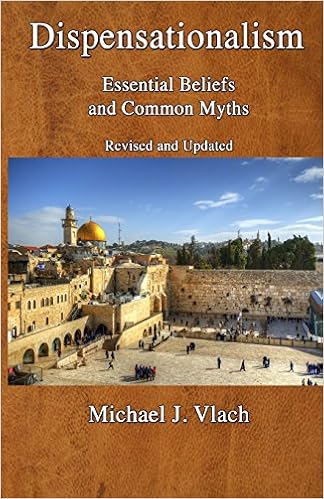
Book Review of Dispensationalism


Michael J. Vlach, DISPENSATIONALISM: REVISED AND UPDATED, Los Angeles, CA, Theological Studies Press, 2017; 112 pages.

Michael Vlach (of Masters Seminary) has produced a good survey on the issues of dispensationalism. He classifies himself as a mix between a revised and progressive dispensationalist. However, any dispensationalist, no matter how he classifies himself does not attempt to settle the issues. The book deals with basic characteristics of dispensationalism: Its fundament beliefs and myths consider the subject. It covers:

A very brief of history of the system and the variations within dispensationalism.

The essential beliefs of dispensationalism. He gives six essential beliefs:
1.      A historical-grammatical hermeneutic.
2.      The church is not a replacement of Israel.
3.      The Church and Israel are distinct. The church is not the new Israel.
4.      The spiritual unity between Jew and Gentile, but does not cancel the distinctions between the two.
5.      Israel has a future of salvation and role in the Messianic kingdom.
6.      The “seed of Abraham” has a promise to Israel and the Gentiles which are different they are not canceling their unique positions.

He proceeds on to myths about dispensationalism. He centers upon the five most popular myths. Including that it teaches two ways of salvation, it is related to Arminianism, antinomianism, non-Lordship salvation, and it primarily centers on seven dispensations. Plus, lesser myths. He calls the myths false ideas.

This revised work includes 3 new chapters: (1) Continuity and Discontinuity in Dispensationalism; (2) Key Differences between Dispensationalism and Covenant Theology, and (3) Recommended Sources on Dispensationalism. He gives a good survey on these issues. He hits the essence of the issues involved. I find the chapters of continuity/discontinuity and its differences with Covenant Theology very good.

The book is short, reader friendly, and does a good job on focusing on some key issues. Issues that are common across the spectrum of dispensation views. It will be helpful to any dispensationalist and non-dispensationalist. He writes from the major Acts 2 position. The are two weaknesses of the book from my view: (1)One weakness is that he completely overlooks the mid-acts dispensational position. (2) He also ignores Dispensational Theologies (such as Lewis Sperry Chafer and Charles F Baker) on his resource list. Neither take away from this excellent work. He has produced a consistent introduction to the field. It will be a helpful introduction to dispensationalism, ideal for beginning students, and will clarify some issues within the field. I found it to be an enjoyable read and refresher on dispensationalism. 

Pastor Jim Gray
Berean Advocate
Maricopa AZ

Saturday, May 30, 2015

History and Dispensationalism


What is this world coming to? Ever hear that question? It is mostly asked with the sense of confusion and frustration as to the reason events happen. Something happens that throws our sense of direction and morality off, and in confusion or frustration we ask, “What is this world coming to?” But in reality that is a fair question to ask. The answer is what can be defined as our philosophy of history and our answer to the quest for meaning. Every generation faces that question and search, not only as a society, but as a individual.


What is a philosophy of history? It is a systematic interpretation of universal history in accordance with a principle by which historical events and successions are unified and directed toward ultimate meaning.[1]

By this definition, we can see that the Bible gives a philosophy of history, although it is not a textbook on the philosophy of history. However it meets the requirements that are necessary for a philosophy of history.
  1. It explains the why of historic events in an organized way.
  2. It covers the whole scope of history from beginning to end.
  3. It has a unifying principle which ties history together.
  4. It assigns ultimate meaning to history.

The Bible fulfills these requirements. Briefly, the Bible shows that history is controlled by God in the outworking of His purpose. The events of history are really a struggle between rebellion, redemption, and restoration. It covers the beginning and ending of history (Genesis to Revelation). The ultimate meaning or goal of history is the redemption of man for the glory of God.

Dispensationalism has a direct relationship to the Biblical philosophy of history. Dispensationalism or the study of dispensations aimed at developing the Bible’s philosophy of history on the basis of God’s eternal purpose. That eternal purpose is expressed in Ephesians 3:11, “This was in accordance with the eternal purpose which He carried out in Christ Jesus our Lord.” While there is much that could be said about this verse, the one thing it clearly does is tell us that God has a plan and purpose. It climaxed (but did not end) with the work of Christ Jesus our Lord on the cross. Notice the verse does not say that this was God’s plan in its entirety. But it was in accordance with His purpose. His purpose is still being worked out. “That in the ages to come He might show the surpassing riches of His grace…” (Eph. 2:7). What dispensations do are identify the stages of the outworking of God’s purpose and plan in history as revealed in the Bible.


[1] Karl Lowith, MEANING IN HISTORY (University of Chicago Press, 1949), 1.

Monday, June 2, 2014

THE BIBLE AND DISPENSATIONALISM


by Charles F. Baker

The Bible is a dispensational book. It is patent upon the surface of many passages that not all of the Bible is addressed to nor is written about the same group of people. Surely none of the New Testament epistles were written to people who live before the coming of Christ, and it is just as evident that the Old Testament books were not addressed to those who live under the present dispensation. Upon the basis of this fact some would suppose therefore that those parts of the Bible which were not written to us must be discarded, and in fact this charge has often been made against those who recognize the dispensational character of the Bible. Some have gone as far as to accuse the dispensationalist of destroying the Bible as effectively as does the modernist, only using another method. It has even been claimed that dispensationalism is far worse than open infidelity, because it begins by piously affirming the divine inspiration of the Bible, but ends by cutting it to pieces. Thus sincere people are seduced by this teaching, only to find in the end that they don’t have any Bible left.

We would be as quick as any to denounce any system which would discard any portion of the Bible. We believe that the wonderful, divine character of the Bible is seen in the fact that while its various parts were written over many centuries and to peoples under different dispensations of God’s government, it is ALL profitable for us today. Only a divinely inspired book could posses such a character. The Scripture itself is clear on this point: it is “profitable for doctrine, reproof, for correction, for instruction in righteousness; that the man of God may be perfect, thoroughly furnished unto all good works.


From BIBLE TRUTH, 14-15.