Showing posts with label Daniel. Show all posts

Monday, May 20, 2013

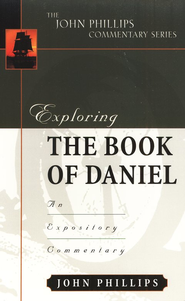
Review: EXPLORING DANIEL


EXPLORING THE BOOK OF DANIEL by John Phillips. Published by Kregel Publications, Grand Rapids, MI. 2004.
Exploring Daniel  -     
        By: John Phillips


John Phillips has given us a delightful nontechnical expository commentary of the key prophet of Daniel. It is very reader friendly, ideal for preachers, Sunday school teachers, and laymen. He writes from a preacher and teacher’s heart aimed at the ordinary believer. Daniel is just one commentary in a set that includes a number of Old Testament books, and the whole New Testament.

In this commentary your will find:
  • A presentation of the prophet Daniel that is clear, practical, and concise. He has a gift that enables him to outline in a clear understandable way. (Outlining seems to be a gift and a valuable feature of his writings).
  • His exposition is not a verse-by-verse presentation, as much as it is a section-by- section that teaches the basic content of Daniel in which the historical and the prophetic are weaved together in an understandable exposition of the book.
  • His exposition is from a dispensational premillennial view, upholding the futurist view of the tribulation and millennium.
  • It is a homiletical goldmine, practical with good illustrations of the truths contained in Daniel.
  • He upholds the Divine inspiration and authoritative view of Daniel.
  • He includes a number of appendixes which deal with such things as Daniel’s authorship; the testimony of Christ; Babylon; certain prophecies; and dates. There are 23 in all which are informative and concise.

This commentary will delight you heart and inform your head. It is an ideal, basic commentary for all.


[Thanks to Kregel for providing a free copy of this book for my honest review.] 

Tuesday, August 28, 2012

OLIVET DISCOURSE #9


THE GREAT TRIBULATION Part 2

Matthew 24:15-28
Mark 13:14-20
 

THE INAUGURAL EVENT: THE ABOMINATION OF DESOLATION

It is the midway point of the tribulation that is now the focus of the Olivet Discourse. The event that signals the midpoint is the “abomination of desolation.”  The phrase is made up of two words: First, is the Greek word bdelugma, denoting “a subject of abhorrence,”[1] an abomination that is detestable to God. Second, is the Greek word eremois is used in the sense of making desolate. The abomination of desolation is “a substitute name or byname for a detestable and idolatrous action or image”[2] that desecrates the Temple. Idol worship has always been, and still is, abominable to God (Ezekiel 5:9, 11; 6:9).

The prophet Daniel refers to the abomination of desolation three times (Daniel 9:27; 11:1; 12:11) from which we learn:

·         The event occurs in the middle of the Seventieth Week of Daniel’s prophecy (Daniel 9:27).

·         A person is involved (called “the prince of the people”), who will establish and confirm a covenant with the nation Israel, and then break it by this act of abomination (Daniel 7:26-27). A careful student will deduce how things from this verse in relation to its fulfillment: First, the temple must be rebuilt before or during the tribulation period. It is apparent that this act is committed in the temple, therefore, it must be standing. Second, is the exercise of Levitical practice must be reinstated, as evident from the fact of daily sacrifices. This abomination will take place it the sanctuary, and will profane it, making it desolate (Daniel 11:31). All this mades the rebuilding of the Temple necessary before these events occur.
One cannot find fulfillment of this in the events of 70 AD. The prophecy is not ambiguous. It depicts a covenant been Israel and the person involved. No such covenant existed in 70 AD; not with Rome, Titus, or Zealots of the time. The destruction of the temple in 70 AD can not be the fulfillment of this event.
Rumors of the rebuilding of the temple have sufficed from time to time since 1948. It has been told that all the elements to rebuild the temple are in place. But there are three major reasons why the temple has not been rebuilt. (1) The Dome of the Rock is on the grounds now, which is a sacred Islamic shrine. That is a major roadblock to overcome. (2) Modern Reformed Judaism sees no need for the temple. And (3) the belief of Orthodox Jews that the Messiah will come and rebuild the temple. This does not mean there is no movement to rebuild the temple. However, this group is not yet a majority in Israel. However, the temple Institute, an organization dedicated to seeing things are in place to rebuild the temple, is alive and working.

·         The abomination is “set up” in the sanctuary of the temple (Daniel 12:11). These words suggest an image of some type. It will no doubt be the image of the beast referred to in Revelation 13:14. This is the abomination of desolation.

·         The abomination will last 1290 days. The time reference causes some problems that must be dealt with. In this chapter of Daniel we have another time reference of “a time, times, and half a time” It is generally agreed that the time referred to in this phrase is equal to 1260 days, or 42 months, or three and one half years. This is in contrast to the 1290 days in Daniel 12:11. In Daniel 12:12 we are told blessed are tohose who can wait 1335 days, which is 75 days longer than the 1260 days. So we have three figures 1260; 1290 (30 days longer); and 1335 days (75 days longer from the 1260).
How do we make sense of the differences in time? Most Bible students account for the differences after the 1260 days of the great tribulation. Feinberg states this view, saying the extra days: “…may have been included as the time needed by the Lord Jesus Christ to purge ‘out of His kingdom all stumbling blocks, and those who commit lawlessness’ (Matthew 13:41). The visible coming of the Lord, however, will occur at the end of the 1260 days of the great tribulation (Matthew 24:29-30; Mark 12:14-16).[3]
It is conceivable, however, some of these days extra days could be placed in the middle of the tribulation. The term “middle of the week” in Daniel 9:27 is not specific. In other words, the beginning of the abomination may begin before the exact numerical midway point in the tribulation. This may account for the extra 30 days mentioned, since the text clearly says this time begins “from the time the regular sacrifice is abolished.” This is the “terminus a quo” for the 1290 days. The number suggests the number of days the abomination of desolation is “set up.” It is hard to imagine the image standing for 30 days after the coming of Christ. Because so little information is revealed to us. A dogmatic determination is hard to make.
As for the 1335 days, one will observe that there is no “terminus a quo” mentioned in the passage. It implies 45 days beyond the 1290. If the 30 days beyond the 1260 are before its beginning, the additional 45 days seem to fit well at the end of the period, for it is a reference to waiting. Feinberg suggests they could end in the celebration of the first millennial Feast of Booths mentioned in Zechariah 14:16-21, but “this cannot be proved with certainty.”[4] The only thing that can be said with certainty is our uncertainty about what these extra days stand for, or what take place during these days.


There can be little question that the abomination of desolation for Christ and Daniel is the same event. Some try to find fulfillment of this event in history, but have fallen short. One is hard pressed to find fulfillment of this event in history. Nothing comes near it, not even the destruction of the city and temple in 70 AD. The key to correct interpretation is not seen in the events as much as the person involved. In Daniel 9:7 the “he” is the antecedent of the “prince that shall come” (Daniel 9:26). In Mark 13:14 the masculine participle personifies the abomination into some concrete figure, an actual person. This person will set himself up as god in the temple. Paul calls this person the “man of sin” (2 Thessalonians 2:3-4).


Attempts have been made to identify this person historically. One attempt was Antiochus Epiphanes. It is based on Daniel 11:31, which is a reference to the contamination of the temple. History does record the fact that Antiochus did erect something in the precincts of the temple. Some say it was a pagan altar upon which swine was offered. Others say it was an image of Zeus in the image of Antiochus. Certainly this is a historical picture or foreshadowing of the prince that shall come, but clearly is not a fulfillment of what Christ is teaching in this discourse. There are two main reasons for this: First, the words of the discourse take the prophecy out of the realm of past history and place it into the future. Both Matthew and Mark clearly present this person as coming in the future. The words, “when therefore ye see” (Matthew 24:15) point forward to the event or person, not back to a person in history. Second, the context tells us that “immediately after the tribulation of those days” will be the second coming of Christ. Antiochus in no way comes close to the first coming of Christ, let alone the second. One cannot find fulfillment of the Olivet Discourse in history.


The next candidate presented as fulfilling this prophecy is Titus, the Roman general that destroyed Jerusalem in 70 AD. At the time the Romans “did offer heathen sacrifices to their ensigns, placed by the eastern gate, when they proclaimed Titus Emperor.”[5] This hardly fulfills prophecy in this discourse for several reasons:

  • There is a question about Titus’s responsibility in the burning of the temple. Gary Cohen tells us:
    “It cannot even be shown that Titus was responsible for the burning of the temple since it was not known whether the timbers of the structure were set on fire by the Romans or by frenzied Jewish zealots who did not want that holy place to fall into Gentile hands.
    “Even, however, if it could be shown that Titus personally set fire to the temple (which, of course, he did not), such destruction would not constitute the abomination of desolation described in 2 Thessalonians 2:3-4 which centers about the blasphemy of a person establishing himself in the Temple to receive worship as God.”[6]
  • The temple sacrifices were not stopped by Titus, but the Jews.
  • No covenant was made with Titus or Vespasian before this time. There was no covenant broken in or around the time of the destruction of Jerusalem.
  • There is not instead flight from Jerusalem in 70 AD. Buswell tells us that “Josephus…describes how Titus had built a wall completely around the city and had it guarded with extreme care…so all hope of escaping was now cut off…”[7]
  • There was no fulfillment of the second coming of Christ in 70 AD. The statement of Colin Brown about the coming refers to an “allusion of Jesus’ ascent to the Father and the accession of authority”[8] simply does not do justice to the context nor the natural understanding of the statement.

 
The only conclusion, in the light of the evidence, is that the person of Titus and the events of 70 AD may be a foreshadowing of the future tribulation, but not the fulfillment of the prophecy given by Christ upon the Mount of Olives. This prophecy to be fulfilled, four precise conditions must be active at the time: (1) Israel must be in the land as a nation. Since 1948 this has been a reality. (2) Israel must have some degree of control of Jerusalem. This became a reality in 1967. (3) The temple must be rebuilt and the Levitical system must be reinstituted. (4) The church must be raptured. According to Paul in 2 Thessalonians 2:3, the restrainer must be taken out of the way. The restrainer the church and the Holy Spirit working in and through the church. Points 3 and 4 are still future. While we may be nearer of this event than ever before, we are not there yet. The fulfillment is still future. When the abomination of desolation occurs, it will inaugurate the time of the great tribulation, one like the world has never seen


[1]  W. FORESTER, “Bdelyssomal, bdelygme, bdelyktos,” TDTNT, 103.
[2]  W.C. Kalser Jr, “Desolating Sacrilege” ISBE, 1:831. 
[3]  Charles Lee Feinberg, DANIEL: THE MAN AND HIS VISIONS, 186-187.
[4]  Ibid, 187.
[5]  J.W. Shepard, THE CHRIST OF THE GOSPELS, 517.
[6]  Gary G. Cohen, “Is the Abomination of Desolation Past?” MOODY MONTHLY, April 1975, 33.
[7]  J. Oliver Buswell, SYSTEMATIC THEOLOGY, 2:403.
[8]  Colin Brown, “Present,” NEW INTERNATIONAL DICTIONARY OF NEW TESTAMENT THEOLOGY, 2:917.

Friday, August 3, 2012

OLIVET DISCOURSE #5


TIMES OF THE GENTILES
Luke 21:24


Special attention is required of the phrase: “Jerusalem shall be trodden down of the Gentiles until the times of the Gentiles be fulfilled” (Luke 21:24). In light of the events of the last 50 years, especially the Jewish possession of the city of Jerusalem since 1967, many have rushed to see fulfillment in this passage. However, Walvoord warned: “A superficial study of this passage would seem to indicate this is the case, and that now Israel is moving into a new phase of its long history. Careful students, acquainted with the history of interpretation of this verse, however, sense the danger of reaching too hasty a conclusion.”[1]

Interpretations of this verse have varied from being symbolic of Gentile spiritual prominence over the disbelieving failure of Israel, to the physical possession of the city as essential for the times to be in effect. Many conclude that the times of the Gentiles have ended. But is that the case? The answer centers upon three questions: First, what are the “the times of the Gentiles”? Second, what does “trampled underfoot” mean? Third, what event ends this time of the Gentiles? We will center our thoughts around these questions.

WHAT IS THE TIME OF THE GENTILES?

The phrase kairoi ethnon (“times of the Gentiles”) is only found in this passage in Luke. This makes it difficult to understand. When taken in context the phrase indicates the idea of Gentile supremacy and judgment. Tone of the passage indicates it is an allotted time of Gentile domination of the city.

Another phrase that is similar, but not identical, is used by Paul in Romans 11:25—“the fullness of the Gentiles.” Many feel it is related if not identical to the times of the Gentiles. Are the times of the Gentiles and the fullness of the Gentiles related? If so, how? A careful comparison and study shows that the natures of the two periods are different. The times of the Gentiles are political in nature, while the fullness of the Gentiles is spiritual. It is true that these two periods may overlap in time, but they are not identical.

The political domination of Jerusalem began in the days of the Babylonian kingdom when Jerusalem fell into the hands of that great Gentile kingdom. The event is recorded in 2 Kings 24:10-17. On March 15, 597 BC, Nebuchadnezzar marched into Jerusalem and took King Jehoiachin captive. It is at this point that the political overlording by Gentile powers began.

The prophet Daniel portrays the course of the times of the Gentiles in his prophecies. His prophecies especially handle the subject of Gentile domination and the chastisement of Israel. He gives two main prophecies that describe and speak to the course of the times of the Gentiles:

·         Daniel 2.

The figure of the great image speaks of the Gentile powers. It gives the details of who will have great domination over the world and Israel during the times of the Gentiles. Five great Gentile empires and powers are presented by the various elements of the image. It is generally acknowledged the gold represents the Babylonian empire; the silver, the Medo-Persian empire; the brass, the Grecian empire; the iron, the Roman empire; and the mixture of iron and clay as the revived Roman empire. Four of the five empires have already entered and exited the stage of history, although Phillips notes that the “Roman empire has actually lived on down through the centuries in the languages and laws of the West.”[2] The fifth empire is yet to appear. Attempts at revival of the old roman empire have all but failed thus far in history. Someday there will be “ten toes” (nations) that will eventually succeed in this revival. Ten nations will come to form a revival of the great Roman empire. Many look for revival to succeed by means of the European common market.

·         Daniel 7

This second prophecy covers the same kingdoms, only under the images of beasts. The nations are represented differently because of the viewpoints of the two chapters. Daniel 2 looks at the kingdom from a human viewpoint, while chapter 7 presents the divine viewpoint. Harry Bultema communicates this well, writing: “The heathen king saw everything from the human and terrestrial point of view, and for that reason the world was a striking image of mankind. Daniel considered the world in its striking image of mankind. Daniel considered the world in its essence and judged it moral quality and so saw it as wild and savage beasts. The heathen king saw in Christ nothing more than a dislodged rock rolling down the mountainside; Daniel saw him as the Son of Man, coming in majesty and glory.”[3]
 

In both passages, Daniel gives the times of the Gentiles a very precise beginning and ending. It began with the Babylonian king Nebuchadnezzar taking Jerusalem and will end with the second Coming of Christ in Glory (Daniel 2:44-45; 7:27). Thus, the time of the Gentiles is the time of Gentile political rule and influence over Jerusalem that will end when “the stone cut out without hands,” destroys that rule and influence.

The “fullness of the Gentiles” on the other hand, refers to the spiritual rule or influence given to the Gentiles by God over and apart from the nation Israel. Israel during this time is spiritually set aside. Before this time of fullness which will be during the time of the Gentiles, blessings will are to be received by and through the Jews (Esther 8:15-17). Even during the ministry of our Lord on earth, he declared that “salvation is of the Jews.” During this time the Gentiles were still strangers from the covenants and without God in the world (Ephesians 2:12).

Today that is no longer the case. With the ministry of the Apostle Paul we see a turning of salvation away from the Jews unto the Gentiles (Acts 13:46; 28:28). This marks the beginning of Israel’s spiritual fall. It marks a time when salvation comes to the Gentiles, not by Israel’s rule as predicted in the Old Testament (Isaiah 2:3; 25:7; 60:1-3; Jeremiah 3:17; Zechariah 8:20ff), but by their spiritual fall (Romans 11:11) and partial blindness (Romans 11:25). Dwight Pentecost perceptively notes that, “this blindness is a mystery which shows that it is a kind of blindness hitherto unrevealed. Therefore it must be distinguished from both the spiritual blindness, which was the experience of Israel as children of Adam and therefore under the curse of sin, and from willful blindness, which was Israel’s experience in sinning against revealed light. This is a new form of blindness, not hitherto experienced by men. It was the divine visitation of Israel by God because of the national sin of rejecting the Messiah.”[4]

The nature of this blindness is seen in the Greek word porosis. It means to cover, a callus. It suggests that Israel had a callus over their eyes so they could not and cannot see the truth of the gospel as a nation or people. It is partial, showing that it is not individual, for an individual Jew may still come to understand the gospel and be saved. It does suggest that national repentance and salvation is not possible during this time.

This is part of what Paul identifies as the “dispensation of the mystery” (Ephesians 3:9). The apostle defines the characteristics of this mystery as Gentiles being “fellow-heirs and fellow-members of the body, and fellow-partakers of the promise in Christ through the gospel” (Ephesians 3:6). The fullness of the Gentiles is the unique combination of the political and spiritual downfall of the nation Israel that has produced a fullness of spiritual riches and inheritance to the Gentiles, not through the fullness of Israel, but through the Church. It involves the times of the Gentiles, in that it happens within that period, but in and of itself was a mystery until revealed to and through Paul for this present dispensation. The two phrases do not refer to the same thing.

WHAT DOES “TRAMPLED UNDERFOOT” MEAN?

Because of the 1967 war when Jerusalem for the first time in centuries was again under the control of the nation Israel, some have looked upon that as a partial, if not complete, fulfillment of times of the Gentiles. In the light of those events, one must take a look at these words carefully.

The phrase “trampled under foot” is only one word in the Greek text, a present passive participle of pateo. It is transitive meaning to tread underfoot. Thayer says it denotes “to treat with insult and contempt.”[5] Seesemann says that in the Old Testament when the word is used, it means to disparage, it implies arrogance.[6] In Revelation 19:20 it is used figuratively of God and denotes judgment.

The word therefore does not need to be taken as actual physical occupation, but must at least speak of influence and domination of some type. There can be no question that today Jerusalem continues to be greatly influenced by the West, and dominated by its Gentile contempt and arrogance. If it were not for Gentile support and assistance of the West, the city would not be in the hands of Israel today. It is a divided city nationally, and still experiences the contempt and arrogance of much of the Gentile world.

THE EVENT THAT ENDS THE TIMES OF THE GENTILES

Inherent in the phrase “until the times of the Gentiles be fulfilled” is that this period will end and be terminated. The facts of political domination of the Gentiles will not only be the time is limited, but it will end with a degree of vindication. The formula in Luke is to immediately travel forward to when this time will be fulfilled—the return of Christ (Luke 21:25-28). Every prophecy related to the fulfillment of the times of the Gentiles points to this great cosmic event (cf. Daniel 2:44-45; 7:26-27). The connection cannot be denied. The end of the times of the Gentiles and the second Coming of Christ are woven together in Scripture. In this light, we can say that this time has not yet ended. We are still living in this time frame.

Contemporary events are not to be construed as fulfillment. This does not mean that they are unimportant. The importance must be seen in the light of prophetic Scripture. Before the fulfillment can be complete, Israel must be in the land and possess the city. Prophecy takes that for granted. When the end comes, Israel will be a nation, have control of the city, and the temple will be standing (Revelation 11:1). It is when the temple is standing that the last treading under foot will occur. Revelation 11:2 says it will last 42 months. Contemporary events are setting the stage for the coming final events predicted in the Olivet discourse. Stage setting must not be confused with fulfillment. The play does not start until the stage has completely been set.

In conclusion there are three reasons the times of the Gentiles has not been fulfilled:

·         The times of the Gentiles are not complete for the Lord Jesus Christ has not returned. His coming ends this period.

·         The fullness of the Gentiles is present and has not been completed. The evidence of this is the presence of the Church and the lack of Israel’s conversion to Christ.

·         Prophecy of another treading of the city is predicted in Zechariah 12:3 and Revelation 11:2. Both passages are still to be fulfilled and speak of the future Tribulation period.


[1]  John F. Walvoord, “The Times of the Gentiles” BIBLOTHECA SACRA, January 1968, 3.
[2]  John Phillips, EXPLORING THE FUTURE, 33.
[3]  Harry Bultema, COMMENTARY ON DANIEL, 200.
[4]  J. Dwight Pentecost, THINGS TO COME, 302.
[5]  Joseph H Thayer, GREEK-ENGLISH LEXICON OF THE NEW TESTAMENT, 494.
[6]  M. Seeseman, “Pateo,” THE DICTIONARY OF THE NEW TESTAMENT, (Abridged), 804.