Sunday, October 25, 2015

Studies in Colossians #6

Elaboration of Thanksgiving (1:4-8)
Part 2


James R. Gray

(b) Its actions (1:6-8)

Paul’s thanksgiving is not simply linked to the characteristics of the Gospel that believers in Colossae possessed, but it also is linked to the actions of the gospel through them. They were channels of faith, love and hope in the Gospel. It had produced certain actions or results in and through them. He continues to thank God for these results:

(1) Fruitfulness. (1:6)
“Which has come to you, just as it has in all the world also;” This phrase refers to the truth of the gospel—The Mystery (v. 5, cf. Eph. 3:1-10). The word “come” is in the present tense, indicating that which came and is still present. Campbell suggests it would be better translated “which is present” in this context.[1] This Gospel is present in the world. It is best to take this as referring to the gospel in transforming people in other parts of the world as it did in Colossae. This is not to be taken that the Gospel had been preached in the entire world as in fulfillment of the Kingdom commission (Matthew 24:14; Mark 13:10), as some hold. The claim of Paul is to the appeal and scope of the preaching of the Gospel. The preposition is en, and commonly translated “in.” It is a preposition of sphere, and “signifies the location where the preaching takes place.”[2] Paul is talking about the sphere of preaching, not that every creature was preached unto. The best translation of the praise is “preached in all creation under heaven.” This verse is not referring to a fulfillment of the Great Commission, nor that every creature has heard the gospel. In fact, if I understand John in Revelation, this commission will not be completely fulfilled until end times, and not simply by men, but will be aided by an angel (Rev. 14:6).[3]

The stress is on the idea that where the Gospel is preached in the world, it brings forth fruit bearing power. Fruit bearing is the emphasis here and expresses the inherent power of the gospel. The text reads, “it is constantly bearing fruit” (1:6). This is one word in the Greek: karpophoroumenon. It means to bear or produce fruit, or generating fruit. Fruit comes by the inherint power of the Gospel. This fruit is described in Galatians 2:20. It is the “fruit unto holiness” (Rom. 6:22) that is manifested in the life of the believer. It is in the middle voice, expressing fruit that is constantly or continually being produced.[4] In connection with the fruit, most modern translations bring out the continual idea with the words, “and increasing” (NASB). The words are found in many of the Greek texts, but not brought out in the KJV. The Greek word is auxanomenon, meaning to grow, increasing. The gospel comes in power to both produce fruit and grow. “There is something wrong with the preaching if the gospel does not bear fruit and if it does not continue to grow,” comments Baker.[5] Is it producing and increasing in our lives? It was in the Colossians, and it should be in us as well.

This fruitfulness began “even [as it has been doing][6] in you also since the day you heard [of it] and understood the grace of God in truth;” On that day two things happened. First, they “heard” the gospel of grace. Hearing the Word is the first step of receiving the Word by faith (Rom. 10:14). This means the gospel of grace must be broadcast, spoken, or preached, if it is to be heard. We are to preach the Word so others may hear the Word (2 Tim. 4:2). Second, they received the Word because they came to “understand” the Gospel. The Greek word is epiginosko, meaning to take in knowledge fully, to fully recognize or understand, to fully comprehend by personal experience or knowledge. It denotes experience and intellectual apprehension of the gospel of grace. It unites the subject and the object. Responding to the gospel is to receive grace, for grace is the essence of the gospel. The gospel of grace transforms the truth of grace into the experience of grace.

(2) Teachable (1:7)
“Just as you learned [it] from Epaphras, our beloved fellow bond-servant” (1:7). They learned grace for they were taught it. Not only were the Colossians fruitful by the empowering gospel of grace, they were also teachable. The word translated learned is the Greek word manthano meaning to acquire knowledge, ascertain, not only by receiving facts, but by use or practice of that knowledge. It is the basis of the word disciple (matheteusate), one who is a learner from a teacher. To be a disciple involves two things: first, salvation, and, second, being instructed in the truth and its acceptance.

One learns from a teacher, in this case—Epaphras. He was the one who communicated and instructed them in the gospel of grace. This indicates Epaphras had seen his task in Colossae not simply as winning them to the faith but instructing them in the truth of the gospel of grace. Some indicate that the apostle chose the verb learn intentionally, for it is a rare word, so as to endorse Epaphras and his ministry over against the false teachers that were found in the city.[7] This endorsement was based upon these important things:

First, Epaphras’ servanthood.  He was a fellow servant. The Greek word is sundoulou meaning a joint servant. This term appears only in Colossians (here and in 4:7).  Since in Philemon 23, Paul calls him a fellow prisoner, some have indicated that perhaps the word should be understood more in terms of a fellow bound one or prisoner.[8] However, the context of Colossians does not seem to indicate this connection.

Second, “who is a faithful servant of Christ on our behalf.” The word “servant” is the Greek word diakonos, meaning one who serves, retaining its original sense, “waiter on tables.”[9] It is one who ministers to the need of others. In this service, he is “faithful.” He met the greatest qualification of a steward (1 Cor. 4:2). While all God’s servants are in reality fellow servants, there may be more than the simple meaning implied in the term. It is possible that the context indicates a special connection to Paul and his ministry. Some manuscripts read “for us” rather than “for you” as in the KJV. The NASB reads “on our behalf.” The Greek texts vary, and it is debatable which is correct, although most favor the NASB translation.[10] It was likely that he was Paul’s representative in Colossae. This certainly is indicated by the tone of the context. Baker says it indicates that he “was officially a part of Paul’s evangelistic team.”[11] Even if one sees “on your behalf” as correct, it still indicates a special relationship as their delegate to Paul in Rome. Either way, there was a special and close attachment between the two.

(3) Loving (1:8)
“And he also informed us of your love in the Spirit” (1:8). Epaphras declared to Paul the Colossian’s “love in the Spirit.” Interestingly this is the only reference to the Holy Spirit in this epistle. Paul’s representative had kept him informed. Since Paul was in Rome, Epaphras had come to Rome and told them what was happening to the Colossians. While Paul received both good and bad reports, he first conveys the good news. The bad news of the threatening circumstances, which is his purpose in writing, comes later (2:6). Now He gives the good news, their love in the Spirit.  This love has its origin in the Spirit (Gal. 5:22). It was a God-given love that was displayed in the lives of the Colossians. It is the love that is poured out in the believer’s heart by the Holy Spirit (Rom. 5:5). It is the first and greatest fruit of the Holy Spirit. He produces it in the lives of believers today.

We certainly see in these verses (5-8) the power of the gospel. The gospel is good news, and its character is that of truth. Its message of grace is universal, to all regardless of race, gender, nationality, or economic standing. It is alive and fruitful in the lives of those who receive it.


[1]  Campbell, Ernest, A COMMENTARY OF COLOSSIANS & PHILEMON, [Silverton OR, Canyonview, 1982], 24.
[2]  Peter T. O’Brien, WBC: COLOSSIANS, PHILEMON, [Waco TX, Word, 1982], 70.
[3]  James  R  Gray, PROPHECY ON THE MOUNT, Chandler AZ, Berean Advocate Ministries, 1991], 61.
[4]  Lightfoot, COLOSSIANS, 133.
[5]  Baker, UNDERSTNDING THE BODY OF CHRIST, 116.
[6]  Scripture texts that are in brackets are the translator’s in the NEW AMERICAN STANDARD BIBLE, and not found in the Greek text. The translator added them to clarify the meaning of the Greek text.
[7]  O’Brien, COLOSSIANS, 15.
[8]  Campbell, COLOSSIANS, 27.
[9]  Dunn, James D.G., THE NEW INTERNATIONAL GREEK TESTAMENT COMMENTARY: THE EPISTLES TO THE COLOSSIANS AND TO PHILEMON. [Grand Rapids, Eerdmans, 1996] 65.
[10]  It is the translation of choice by the NIV, NASB, RV, and the ASV.  It is favored by Lightfoot, 134; Lenski, 30; O’Brien, 15; Baker, 116.
[11]  Baker, COLOSSIANS, 116.

Saturday, October 24, 2015

Book Review: TOUGH QUESTIONS ABOUT GOD


Walter C. Kaiser Jr., TOUGH QUESTIONS ABOUT GOD AND HIS ACTIONS IN THE OLD TESTAMENT, Grand Rapids MI, Kregel Publications, 2015.


Walter C Kaiser Jr. is no stranger to the Old Testament, teaching it for a good number of years, and having written on it in books and articles. This is a timely book for two reasons: First, for all who has read the Old Testament, many of these questions come to mind, and it is not easy to find suggested answers to these questions. Second, the Old Testament has been used by nonbelievers as attacks on the inconsistency of the Bible. Kaiser deals with 10 questions:
  1. The God of Mercy or the God of Wrath?
  2. The God of Peace or the God of Ethnic Cleansing?
  3. The God of Truth or the God of Deception?
  4. The God of Evolution or the God of Creation?
  5. The God of Grace or the God of Law?
  6. The God of Monogamy or the God of Polygamy?
  7. The God who Rules Satan or the God who Battles Satan?
  8. The God Who is Omniscient or the God who Doesn’t Know the Future?
  9. The God who Elevates Women or the God who Devalues Women?
  10. The God of Freedom with Food or the God of Forbidden Food?

These are not easy questions to answer. They easily are riddled with conflict and confusion. The book deals with historical, biblical, and theological views to these questions. He certainly disagrees with the liberal stance by some scholars who see the God of the Old Testament in sharp contrast with the God of the New Testament. Kaiser leads the reader through these with sound, logical reasoning in trying to reconcile the conflicts. Many of his points are valid. I found the chapters on Omniscience and on Satan most helpful.

Although he offers some interesting insights to these questions; he has left this reader dissatisfied in some respects—e.g. holding that the 10 commandments are valid today, yet not really dealing with the issue of the Sabbath. At times he seems to try to circle around the issues—e.g. deception and polygamy. But he makes the reader think about these important questions. While I may have disagreed with some of his conclusions, there was not a chapter in this book that I did not learn at least something.

Overall, I found it to be a mixed bag. I have reservations about this book and came away a little disappointed. It is not an easy read without some understanding of the issues beforehand; it would be rough going for a naive reader. This is not to say that the book does not have value and serves well in getting the reader to think about these issues. At the end of each chapter there are discussion questions to aid discussion and thinking upon the subject.

I commend Kaiser for taking on these questions and his overall knowledge displayed in the book. One will not agree with some of his conclusions and treatments of the subject matter; however he offers insights that should be considered and should be consulted when dealing with these questions. One should read this book with a guarded mind and  thinking cap on.  

 I received this book free from Kregel Publications for the purpose of reviewing it. I was not required to write a positive review. The opinions I have expressed are my own. I am disclosing this in accordance with the Federal Trade Commission's 16 CFR, Part 255.


Thursday, October 22, 2015

Studies in Colossians #5

Elaboration of Thanksgiving (1:4-8)
Part 1

James R. Gray

(a) Its Cause (1:4-5).
“Since we heard” is a causal clause that gives the basis or reason for the thanksgiving.  This clause is an aorist participle indicating that Paul heard this prior to his praying.  It is because or on the basis of the report he took this action. Paul and Timothy did not know the Colossians personally, but the reports and reputation of the believers motivated their thanksgiving and prayer. By the time Paul writes this epistle there were more than likely a number of reports he had received about the Colossians, after all he spent over three years in the area, being at Ephesus. These reports may well have continued being received by him in Rome. Now under house arrest in Rome, he thinks back over those reports and praises God for them. He and Timothy rejoice over them.

C.F. Baker makes a very good practical observation about Paul’s methodology in this greeting.  He writes:
Paul’s psychology, if we may call it that, is always to commend the saints for their good points, before bringing up any weaknesses or failures on their part.  When we begin by attacking people whom we feel are going astray, we immediately set up a blockage which is very difficult to overcome, and which at the same time creates a spirit of antagonism, closing the mind of the listener to what we have to say.  Paul does not use insincere flattery, but he is truly thankful to God for all who manifest faith in Christ and show their love to the saints.[1]
Paul and Timothy where thankful for three aspects of the Colossians character:

(1) Faith. 
“Since we heard of your faith in Christ Jesus” (1:4) Faith is the beginning point of Christian character and salvation, thus it is mentioned first. Faith means to exercise trust, belief, or to have confidence in. The object of their faith is Christ Jesus. En (in) denotes the sphere in which faith moves and operates. Christ is the sphere in which faith lives and acts. This faith is personal. It is the first component of the believer’s character. The text literally reads “the faith of you.” They walk by faith “in Christ Jesus.” Christ is the object of their faith, but the indication here by the preposition, points to the sphere or environment in which faith is exercised.

(2) Love.
“And the Love which you have for all the saints” (1:4) Love is the next element in the life of a believer; it springs out of faith. Gal. 5:6 tells us that “faith…worketh by love.” Faith is expressed by love for others. “Faith must be exercised in Christ before love for the brethren can follow,” observes Johnson.[2] Lenski makes a worthy observation when he writes:
A love apart from this oneness of faith is a fictitious bond, however devoted and fervent it may be.  Nor is love ever stronger than the faith from which it originates. All of its strength comes from faith alone so that, in order to increase our love, we must first nourish and strengthen our faith.[3]
Love is the “incontestable proof of the reality of the new life (cf. 1 John 3:14).”[4] This type of love is not an inherent moral quality, but a gift of God. The word “love” here is the noun agape, and it means “to esteem, love, indicating a direction of the will and finding one’s joy in something or someone.”[5] It is used of God’s love toward us (Eph. 2:4).  It is the highest form of love.  It is that Calvary love that is self-sacrificing.  Love does not count the cost, nor is any sacrifice too great. We are taught of God “to love one another” (1 Thess. 4:9). The Colossians were channels of God’s love reaching out to “all the saints.”  The Love of God is always outreaching, and not inward directed, nor selfish. It is the love that Christ commands of believers (John 13:34-35), and part of the fruit that the Spirit grows within believers (Gal. 5:22).  This love is directed toward the saints as proof of the genuineness of our faith (James 2:14; 1 John 3:14). The mutual ministry of the body of Christ affords us opportunity to exercise our love toward one another by teaching, helping, and encouraging one another.  We are all to be channels, not reservoirs of His love.

(3) Hope (1:5).
“Because of the hope laid up for you in heaven….” It is of note that this part of the verse begins with the word “because,” not “and.” It is the Greek preposition dia. It is used with the accusative, thus making it have the sense of on account of, or ground for an action. Hope is the motivation behind their faith and love. Moo expresses that “the Colossians need to be reminded that their present experience of faith and love rests on the solid foundation of what God has committed to do for them in the future.”[6] It also serves as the third factor of Paul’s thanksgiving. Paul is thankful for their expression of the Christian triad of faith, love, and hope (1 Cor. 13:13; Rom. 5:1-5; Gal. 5:5-6; 1 Thess. 1:3). Faith, love, and hope are the Pauline trilogy. “Faith is the soil from which the fruit of love springs, and hope is the sunshine which ripens this fruit of love.”[7]  Lightfoot reminds us that, “Faith rests on the past: love works in the present: hope looks to the future.”[8]

Our hope is “laid up for you in heaven.” Hope “is not enjoyed now—but it exists now; it is kept in store, and will certainly be possessed”[9] Hope projects us beyond the present, and brings expectation or longing for what is ahead. Hope and assurance are merged in this passage. The Greek word for “laid up” is apokeimai, a compound word to lay or set away for preservation, to reserve or to store. Hope is God’s layaway plan. The word indicates security or assurance of what has been laid away has no possibility of loss. The present tense brings this out, it speaks of action in progress—it had a point of beginning and continues to be laid up for us. 

This is a specific hope, as seen by the used of the article—it is “the hope.” “The biblical idea of hope can be expressed in the simple formula hope equals desire plus expectation.”[10] Our hope and expectation is not simply a thing or an event; rather it is a person—the Lord Jesus Christ (Col. 1:27). This hope has many aspects: salvation (1 Thess. 5:8); righteousness (Gal 5:5); transfiguration or resurrection (1 Cor. 15:52-55); eternal life (Titus 1:2, 3:7); and glory (Rom. 5:2, Col. 1:27). We gain these in the person of our Lord and realize them in His coming for His own (1 Thess. 4:13-18; 1 Cor. 15:51-53). Our hope is a living (1 Peter 1:31), purifying (1 John 3:13), unifying (Eph 4:4), and a blessed hope (Titus 2:13). It is a personal hope where the object is a person, the Lord Jesus Christ. The location where this hope is found is “in heaven” or literally, “in the heavens” where Christ is sitting at the right hand of the Father. It is at the same location as the source of our spiritual blessings (Eph. 1:3) and the place of our citizenship (Phil 3:20).

“Of which you previously heard in the word of truth, the gospel” (1:5). The phrase points to the source of the knowledge of their hope. “Of which” is the Greek word hen, a relative pronoun referring back to the word hope. This hope had been expounded upon in the presentation of the truth of the gospel. Apart from the revelation of God’s truth, we would know nothing of this hope. This phrase “truth, the gospel” is used here and in Galatians 2:5, 14. In Galatians it is clear this phrase is used in the context of Paul’s message in comparison to the Twelve. The truth of the Gospel was committed to him by special revelation (cf. Eph. 3:1-10). This truth is the Mystery (Eph. 3:1-10) which says Jews and Gentiles are now one in Christ.

Thus, they had “heard” the Word. The Word of truth they heard in the Gospel from Epaphras was a contrast with the falsehood of their recent teachers. This seems reasonable in light of the context where the Gospel was being attacked as not sufficient. It is clear from the context that the true gospel had been presented unto them. This gospel consists of truth as its major characteristic, for it is the Word of God, who cannot lie. The emphasis is on what they had heard—the truth of the Gospel—and to remain true to it.


[1]  C.F. Baker, UNDERSTANDING THE BODY OF CHRIST: A PAULINE TRILOGY, [Grand Rapids, Grace Bible College Publication, 1985], 115.
[2]  S. Lewis Johnson, “Studies in Colossians-Part 2: Spiritual Knowledge and a Worthy Walk,” BIBIOTHECA SACRA, October 1961, 338.
[3]  R.C.H. Lenski, THE INTERPRETATION OF COLOSSIANS, THESSALONIANS, TIMOTHY, TITUS, PHILEMON, [Minneapolis MN, Augsburg Publishing House, 1946],  22.
[4]  Johnson, “Spiritual Knowledge and a Worthy Walk,” 338.
[5]  Spiros Zodhiates, THE COMPLETE WORD STUDY DICTIONARY: NEW TESTAMENT,[Chattanooga TN, AMG Publishers, 1002], 64.
[6]  Douglas J. Moo, PNTC: THE LETTERS TO THE COLOSSIANS AND TO PHILEMON, [Grand Rapids MI, Eerdmans, 2008], 85
[7]  Ibid., 23.
[8]  J.B. Lightfoot, SAINT PAUL’S EPISTLES TO THE COLOSSIANS AND TO PHILEMON, [New York, Macillan, 1890], 132
[9]  John Eadie, COMMENTARY ON THE EPISTLE OF PAUL TO THE COLOSSIANS,  [Grand Rapids MI, Zondervan, reprint 1957], 10.
[10]  Bing, Charles, “The Warning of Colossians 1:21-23,” BIBLIOTHECA SACRA, January 2007, 78. 

Saturday, October 3, 2015

5 FAITHFUL WITNESSES IN DIFFICULT PLACES

NOAH in a godless generation (2 Peter 2:5)
JOSEPH in the Officer's House (Genesis 49:2-9)
DAVID in the King's Palace (1 Samuel 16:14-23)
DANIEL in a Heathen Court (Daniel 1:8)
MORDECAI in the Enemy's Presence (Esther 2:1-6)

Friday, October 2, 2015

Pastor as Public Theologian

THE PASTOR AS PUBLIC THEOLOGIAN, Kevin J. Vanhoozer and Owen Strachan, (Grand Rapids MI, Baker Academic, 2015) 221 pages.


It was great expectation that I read this book. In recent years I have been concern about if we were really teaching our people the divine perspective about life and the Christian world view. Neither can be done properly without teaching theology. I have observed that many pulpits are sacrificing good theology on the altar of relevance. I agree whole heartedly with the authors that to many Pastors have a wrong perspective on ministry—substituting their office to that of counselors, leaders, and motivators, instead of teachers, preachers, and theologians.  Their proposal is threefold: First, Pastors are and always have been theologians. Second, every theologian is in some sense a public theologian. Third, the purpose of the pastor-theologian being a public intellectual is to serve the people of God by building them up in faith (pages 15-16). Their purpose is to build up people of Christ.

However, the methodology of the book is interesting and helpful. The authors write a chapter and then they have Pastoral perspectives on what they wrote. I found this especially helpful and practical. After the introduction, the book is divided into two parts: (1) Biblical theology and Historical Theology. This is a overview of history of ministry from the Old Testament to modern times. First, he correlates the ministry of theologian to that of the three-fold office found in the Old Testament: prophet, priest, and king. The author sees the Pastor as priest in being set apart for a set apart people (ministering grace); prophet as proclaiming of truth (ministering truth) ; and king as a personification of divine wisdom (ministering wisdom). In the early church, there was a strong emphasis on the Pastor as teacher and the pastorate as a theological office. That view shifted during the medieval times more from the pew to the scholastic, it took the reformation to revive it back to the local pastor and the pew. The preaching became more expository in nature (which seems to me is the real power behind the pastor as theologian). In modern times the pastor theologian has been compromised by populism, professional, and taming of the Pastorate.  “Theology has become a specialist’s discipline, not a generalist” (page 89). This book certainly calls us back to be pastor theologians.

(2) Systematic Theology and Practical Theology. Throughout the book are some 55 theses on the Pastor as Theologian, which are brought together in the conclusion. He sees being a Pastor-Theologian in very practical terms. The purpose is for cultivating life and for coping with death. To communicate this to our people means we understand God, the world, and ourselves in relation to what we are in Christ. The purpose is to confront people with words, thoughts, and actions of God in their life. The purpose is also to proclaim Christ through the word by preaching and teaching.

The book is filled with wisdom, thoughtful insights, and encouragement. It is a timely book and one needed in today’s world. It is reader friendly, clear, and helpful.

  I received this book free from Baker Academic through the Baker Academic Bloggers program. The opinions I have expressed are my own, and I was not required to write a positive review. I am disclosing this in accordance with the Federal Trade Commission’s 16 CFR, Part 255 

Tuesday, September 22, 2015

CHAIN OF FELLOWSHIP

PAUL’S SEVEN-LINKED CHAIN OF FELLOWSHIP


Fellow-heirs (Eph. 3:6)—of One Inheritance
Fellow-members (Eph. 3:6)—of One Body
Fellow-partakers (Eph. 3:6)—of One Calling
Fellow-citizens (Eph. 2:19)—of One home
Fellow-laborers (Eph. 4:3)—of One Master
Fellow-soldiers (Phil. 2:25)—in One Warfare
Fellow-prisoners (Rom. 16:7)—in One Hope. 

Wednesday, September 16, 2015

Chart: Mary's Magnificat

OLD TESTAMENT PARALLELS TO MARY’S MAGNIFICAT________________________________

Luke
Phrase
Psalm
Other Old Testament
1:46
My soul exalts the Lord
34:3; 35:9; 103:1-2; 145:21
Isaiah 61:10
1:47
My spirit has rejoiced in God my Savior

Habakkuk 3:18
1:48
He has regard for the humble state of His bondslave

1 Samuel 1:11; Genesis 30:13; Malachi 3:12
1:49
Mighty One has done great things
126:3; 71:19-21
Job 5:9
1:49
Holy is His name
111:9
Exodus 15:11; Isaiah 47:4; 6:3
1:50
His mercy is upon generation after generation toward those who fear Him
103:17; 118:4; 145:19; 147:11
Exodus 20:6; 1 Kings 8:23
1:51
He has done mighty deeds with His arm
89:11; 98:1
Exodus 15:6-7; Isaiah 40:10; 51:9; 52:10
1:51
He has scattered those who were proud
33:10; 59:11
Job 5:12-13; Daniel 4:27
1:51
The thoughts of their hearts

Genesis 6:5; 8:21; Deuteronomy 29:19
1:52
He has brought down rulers

Job 12:19
1:52
Has exalted those who were humble
107:40-41; 113:6-8
Job 5:11; 24:24; Ezekiel 17:24
1:53
He has filled the hungry with good things
34:10; 107:9; 146:7
Isaiah 65:13
1:54
He has given help to Israel His servant

Isaiah 41:8
1:54
In remembrance of His mercy
98:3

1:55
As he spoke to our fathers
105:8
Genesis 18:18; 22:17; Isaiah 46:3-4; 49:14-16; 63: 7-16: Jeremiah 31:3; 33:24-26: Micah 7:20;
1:55
To Abraham and his descendants forever

Genesis 17;19


Friday, September 11, 2015

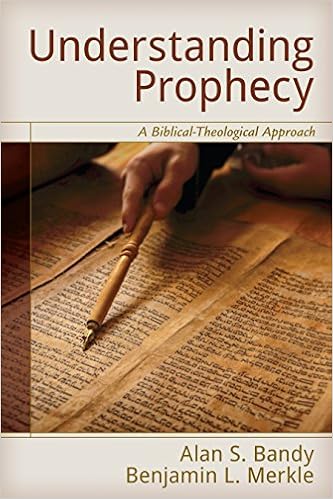
Book Review: UNDERSTANDING PROPHECY


UNDERSTANDING PROPHECY: A Biblical-Theological Approach, Alan S. Bandy & Benjamin L. Merkle, Kregel Academic, Grand Rapids MI, 2015

The aim of this book is to give the reader a framework of how to interpret any passage in the context of the Bible (p.9). The book is unique because the authors have different views of prophecy. Brandy is a historic premillennialist and Merkle is an amillennialist, however both seem to be writing from a covenant theology view. The emphasis seems to uplift areas they have in common and downplay the differences. They also write from a biblical-theological approach, as the title states.

The book is divided into three sections:

Chapters 1-3, deal with the general subject of prophecy and the biblical-theological approach. They clearly uphold inspiration pointing out that “Prophecy is the vehicle for divine revelation” (p. 17). They clearly bring out that the term eschatology is “slippery” term referring to different aspects of the term which can be all-encompassing theologically. They give good keys to understanding prophecy, including the progressive nature of prophecy, thematic, Christocentric, and to be seen from a Biblical-theological perspective. Their general view is to downplay the popular culture caught up in the idea that prophecy is mainly predictive of the future (although they do not deny it, they certainly downplay it), looking more at historical context and its relevance to the original readers. They clearly hold that most prophecy is not predictive in nature, rather centers upon aspects of repentance, social justice, and theological understanding in the historical context of the prophet. Prophecy is primarily forth-telling, and only a small part is fore-telling. They hold that the messages of the prophets are encapsulated in three points:
  • The covenant has been broken, therefore repent!
  • If you refuse to repent, then judgment.
  • Yet, there is hope beyond the judgment for a glorious, future restoration.

These points are well taken. They go on to deal with the forms of prophecy (poetry, pose, apocalyptic, and the challenge of symbolism (which is an attack on the dispensational method). It gives the reader their idea of what biblical theology is, and how it deals with prophecy. To their credit they declare the important presupposition of biblical theology, which all can appreciate:
·         The Bible is God’s Word.
·         God’s Word has a unified message.
·         The unified message of God’s Word centers on Jesus.
·         Jesus’ death, resurrection, and ascension are the climax of redemption history.

Chapters 4-6 focus on Old Testament prophecy. In these chapters they center up the types of Old Testament prophecy: unconditional, conditional, and fulfilled prophecy. They take time to discuss restoration prophecies (Chapter 5). They admit that many passages point to the restoration of Israel, however, they are overly cautious of literal fulfillment of these prophecies. They seem to be more than willing that those should be interpreted mainly symbolically. The reasons in the nature of biblical religion, the unique genre of biblical prophecy, symbolic manner in which the New Testament interprets Old Testament prophecies, and the role of Jesus’ death and resurrection in salvation history. They seem to be saying that these descriptions are fulfilled in some type of code—“The meaning is not expressed in the actual language, but through the actual language of the prophecies” (page 123). The last area they center upon is the Messianic Prophecies that center upon the three offices of Christ—priest, prophet, and king.

Chapters 7-10 deal with the New Testament prophecies. This section is divided into three areas: the coming of Messiah in the gospels and Acts; the epistles, and the book of Revelation. In this section they deal with major prophecy areas in the New Testament. I was especially interested in their comments on the Olivet Discourse. I was somewhat unsatisfied in their treatment; much was oversimplification on the views, especially the futurist view. Although I found their view, “Already-Not Yet” was somewhat interesting, and brought in some good points. Their comments about “left behind” are noteworthy.

In the epistles they center upon the last days. They reject a pretribulational rapture, and the doctrine of the any moment return of Christ. They clearly hold that at least four events must happen before the return of Christ—the gospel preached to the whole world; the conversion of all Israel; the great tribulation; and the coming of Antichrist. They fail to see any differences between the gospels, epistles, and Revelation; common among Covenant theologians.

On Revelation they readily amid that it is one of the most difficult books of the Bible to interpret (p. 224). They take the view that the key of understanding symbolism and spend much of the chapter of this. In the areas of book they consistently chose the figurative or symbolic interpretation. This is true of their overall approach to prophecy saying in their conclusion: “We must resist becoming obsessed with knowing the details of the future because it takes us beyond Scripture into the realm of speculation” (p. 242).

This work on prophecy centers upon common elements between the two authors. The only place that shows disagreement is the two appendixes, and they are very limited: Future conversion of Israel with Bandy seeing it a mass conversion of ethnic Israel in the future. Merkle on the other hand sees it as referring to the Ethnic elect remnant through all history. The other hand is the meaning of the Millennium; which Bandy holds a historical premillennialist and Merkle holding to the amillennialist view. Otherwise, in the major portion of the book one would be hard press to see any difference between the two. There are more differences between historical premillennialist and amillennialist than what are given in the book. Part of the reason for this is both are coming from a Covenant theological view. They downplay literal interpretation of prophecy and the futurist views, and magnify the non-literal view. Do not get me wrong, there are areas in the book that all will agree with, but to me it was lacking and not a satisfying treatment of the subject. They seem to have sacrificed their distinctiveness on the altar of unity.


I received this book free from Kregel Publications for the purpose of reviewing it. I was not required to write a positive review. The opinions I have expressed are my own. I am disclosing this in accordance with the Federal Trade Commission's 16 CFR, Part 255. 

Tuesday, September 8, 2015

Thoughts on John 1:4-5


In John 1:4-5 we come face to face with the literary chain of sorites,[1] (life, life, light, light, darkness, and darkness).[2] These expand on the Word’s participation in creation in this context; later John will expand to salvation, but not here.[3] Notice in creation He is the source of life, his first creative act was light, and the existing darkness was not able to overtake the light. The context of these verses is creation centered. There are three features of the work of Christ in creation:
  • Life—“In Him was life, and the life was the Light” (1:4). There is a parallel to the self-existing life of the Godhead in John 5:26. Life was not created rather it was given (cf. Genesis 2:7; Acts 17:25). There are two clear implications: First, Christ is the life source. Christ empowered the creation with life. He is the source of all life. Second, and somewhat difficult to understand is that His life shared became light, for His “life was the Light of men.” The article used with light in this context is Anaphoric, meaning it is an amplification of life.[4]  Carson correctly states: 
If 1:4...is read in the context of the first three verses, it is more likely that the life inhering in the word is related not to salvation but to creation. The self-existing life of the word was so dispensed at creation that it became the light of the human race...At least in this verse, John is more interested in the source of light (the life of the word) and its purpose (for the human race) than in the mode or purpose of its dispersal.[5]
MacLeod makes three suggestions on this life as light:[6] First, the given life gave significant light in that it was the communication of the knowledge of God. Second, it could be the reflection of God that is seen in His creation (natural or general revelation). Romans 1:20. Third, it is the direct communication that the Lord had with Adam and Eve in the garden. I favor the first suggestion which indicates that there is something in man that knows there is a supreme being—the image of God. From it man has the natural illumination of reason and conscience, insufficient as that may be to bring one to the point of salvation—cf. Romans 2:15.
  • Light—“The Light shines in the darkness” (1:5a). Notice that the word “shines” is in the present tense, indicating that innate light of creation still is active in man. It continues in spite of man’s rebellion/darkness. This is a clear allusion to the fall (Genesis 3). “The light shone in the darkness of the act of creation, and it continues to shine in the darkness of fallen humanity.”[7] This light anticipates the greater light of the Incarnate Christ and the light He gives in salvation (John 1:14). Harris notes “The question of whether John has in mind here the pre-incarnate Christ or the incarnate Christ is probably too specific.”[8] John is using the old creation to set up the light which shines in the work of Jesus Christ.
  • Darkness—“The darkness did not comprehend it.” Darkness in John is positive evil and it speaks of being the environment of the lost. In the plan of God, darkness cannot overtake the power of light. There has been debate over the translation of comprehend. The Greek word is katalambano, meaning to grasp, obtain, to lay hold of, overtake, apprehend, or comprehend. Many take the word to indicate that it has no power to overtake the light and suggest a better translation would be “overpower.” Darkness cannot penetrate or extinguish the light. This statement is in the aorist tense indicating that the failure of overpowering took place in the point of time—at the Cross.


[1]  Sorites: an argument consisting of propositions so arranged that the predicate of any one forms the subject of the next and the conclusion unites the subject of the first proposition with the predicate of the last. (Merrian-Webster’s Collegiate Dictionary, 11th Edition). It is sometimes referred to as the paradox of the heap, for the Greek word means heap.
[2]  Craig Keener, THE GOSPEL OF JOHN, [Peabody MA, Hendrickson, 2003], 1:383.
[3]  MacLeod, “The Creation of the Universe by the Word: John 1:3-5,” 197.
[4]  See Daniel Wallace, GREEK GRAMMAR: BEYOND THE BASICS, [Grand Rapids MI, Zondervan, 1996], 217-220.
[5]  D,A, Carson, PNTC: THE GOSPEL ACCORDING TO JOHN, [Grand Rapids MI, Eerdmans, 1991], 119.
[6]  MacLeod, ‘The Creation of the Universe by the Lord: John 1:3-5,” BIBLIOTHECA SACRA, January 2003, 197-198.
[7]  George Beasley-Murray, WBC: JOHN, [Waco TX, Word, 1987], 11.
[8]  Harris, JOHN, [1:5], www.Bible.org, n.p. 

Sunday, September 6, 2015

Book Review; Comfort's Commentary


Philip Westley Comfort, A COMMENTARY ON THE MANUSCRIPTS AND TEST OF THE NEW TESTAMENT, Grand Rapids MI, Kregel Academic, 2015.

Philip Comfort is well-known for his writings concerning the Greek text. In this latest one he gives a handy aid for anyone who uses the Greek text. It is really a commentary on the variants found in the many New Testament manuscripts, arranged in order of their appearance in the New Testament. However, I found it is more than that. In addition, Comfort has a very helpful introduction. I found it well worth reading. He gives special features of his work:
  • He seems to center on 2nd Century manuscripts, although he does not neglect the others. I personally like this emphasis over some of the other textual mythology. Clearly these would be closer to the originals.
  • He brings out the nomina sacra (sacred names). These are special markings in the manuscripts that do not appear in any printed Greek text. In the manuscripts they are presented with special calligraphy to distinguish the names as sacred. He points them out in his commentary—claiming no other commentary does so. He also has a full appendix of the Significance of the Nomina Sacra. This gives this work added value.
  • He gives a list of the earliest manuscripts for each chapter of the New Testament (i.e. Matthew 1 = P1).
  • He also gives an annotated list of the manuscripts of the New Testament (Chapter 2).

The heart of the book is the running commentary of the Greek text variants—giving his view of the correct one and showing the others. Each has the manuscript information in which they are found. Comfort clearly confesses that in some cases the original reading cannot be determined and gives options for the reader. Another feature of this book is that everything is given in English, so one who is not well versed in the Greek text can still gain valuable information from this work.

This will be a handy reference for any Pastor, student, or a well verse layman who spends time in the study of the Bible. It is compact, organized for quick use, and gives good information in a concise, reader friendly way. Its most valuable contribution is in the area of the Nomina Sacra. It will not likely replace the more standard work of Metzger’s textual commentary, but it will be a pleasant supplemental work to it. It is worth having on your bookshelf for quick reference.


 I received this book free from Kregel Publications for the purpose of reviewing it. I was not required to write a positive review. The opinions I have expressed are my own. I am disclosing this in accordance with the Federal Trade Commission's 16 CFR, Part 255.